 1-800-656-4211


Blog
Pine Pollen: The Complete Guide to Its Benefits, Uses, and Limits

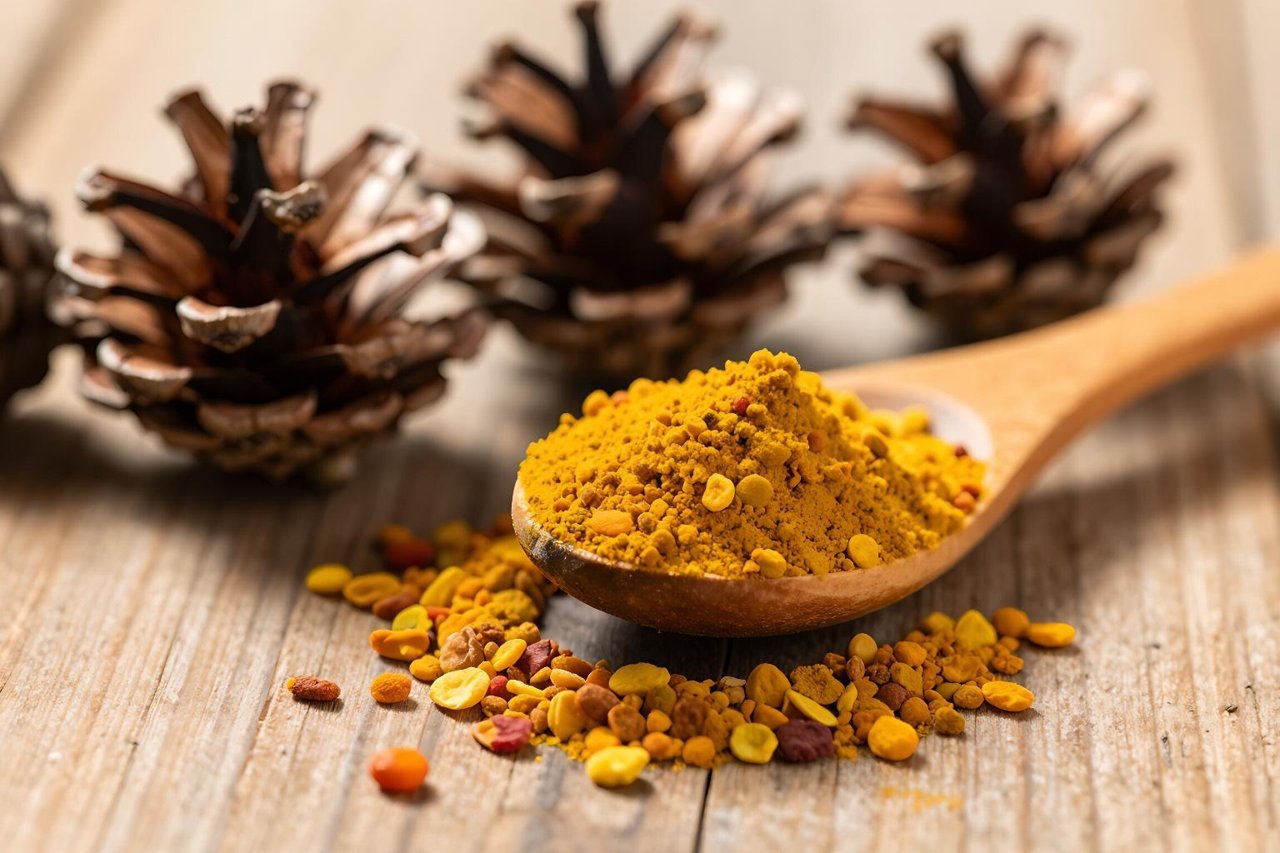
At first glance, pine pollen looks like a jar of bright yellow dust that might make a decent dye. But people in the functional medicine world swear it does much more than colour your smoothie. Harvested from the male cones of pine trees, this fine grain has been used in Traditional Chinese Medicine for centuries to restore energy, support the kidneys, and calm a restless gut. In the current supplement industry, it has a new reputation as a natural testosterone booster, an athletic performance aid, and even a beauty ingredient.
Standing behind these claims are plenty of small studies and lots of colourful marketing. Let’s sort through the evidence, ignore the hype, and figure out whether pine pollen is worth staying in your rotation.
Wait, What Actually Is Pine Pollen?
Pine pollen is the male gametophyte of pine trees. Every spring, when the male cones release clouds of microscopic yellow spores, that dust drifts through forests and eventually lands on screening installed beneath the trees. Commercial pine pollen is usually harvested from Masson’s pine (Pinus massoniana) or Scots pine (Pinus sylvestris) that grow in high-altitude regions of China.
Unlike bee pollen, a mix of many flowers plus bee saliva, pine pollen comes from a single plant species. It is also naturally free of the contamination risk that comes with beehives. But it does have a surprisingly thick outer shell made of sporopollenin, one of the toughest natural polymers on Earth. If that shell stays intact, your body can digest very little of the pollen. That explains why so many high-end brands now sell pine pollen that is processed with enzymes, alcohol, or cell wall cracking. It also tells you that cheap whole powder might not be worth your money.
Pine Pollen: Nutritional Profile
Once the cell wall has been broken, pine pollen reveals a dense nutritional base. Lab analyses commonly list over 20 amino acids, all eight essential ones, plus a mix of B vitamins, vitamin C, beta-carotene, and small amounts of vitamin D and E.
There is also a notable mineral profile.
- Amino acids, particularly arginine and lysine, that help with circulation and tissue repair
- Zinc and magnesium, two minerals that are chronically low in Western diets and closely linked to male hormone health
- Phytosterols, including beta-sitosterol and campesterol, which look like cholesterol and have mild hormone-modulating capacity
- Flavonoids and phenolic acids, which act as antioxidants in cell studies
Marketers often mention trace of testosterone and dehydroepiandrosterone (DHEA) in pine pollen. These compounds are indeed present in the lipid extract, but at levels that are measured in micrograms, not enough to replace your body’s natural hormones. That doesn’t mean the pollen is inert. It just has a more indirect mechanism than the supplement labels suggest.
Pine Pollen Benefits: Where We Have Actual Evidence
The list of health promises attached to pine pollen grows every year. In this section, we update the most researched benefits with practical caveats so you can set realistic expectations. If you’re looking for a rapid-fire list of the common uses, read our earlier roundup of 10 pine pollen benefits and uses. But for exactly how they work, keep reading.
1. Could Support Healthy Testosterone Levels
The majority of pine pollen research focuses on androgenic effects. A 2014 Chinese study on aging mice found that a polysaccharide fraction of pine pollen increased serum testosterone and improved testicular function. Other experiments have shown that phytoandrogens from pine pollen can bind to androgen receptors and activate signalling pathways. However, these papers used concentrated extracts, not a teaspoon of powder. When you ingest the whole pollen, the active compounds make up a small fraction of the total volume.
If pine pollen does alter testosterone, it likely works by freeing up testosterone that is bound to SHBG (sex hormone binding globulin), by lowering cortisol, or by providing zinc for the biosynthesis pathway. That can make a difference for someone with suboptimal nutrition. For a 22-year-old with robust hormones, the effect will probably be imperceptible.
2. Enhancing Workout Performance Without Stimulants
With no caffeine or vasodilators, it’s difficult to sell pine pollen as a classic pre-workout. Still, athlete claims about energy rely on the L-arginine and antioxidant compounds that may support blood flow and muscle oxygenation. An exhaustive swimming study in mice found that pine pollen could extend time to exhaustion, but no similar result exists in trained humans.
If you’re already clocking substantial training volume, pine pollen might give a shove, but you should never swap it for a formula designed around proven ergogenic doses. For a breakdown of what works and what is a buzzword, head to our pre-workout supplements guide. We compared each ingredient against human trials.
3. May Help with Hair Loss – But Not as a Standalone
Pine pollen has become a darling in hair loss forums because beta-sitosterol may inhibit 5-alpha-reductase, the enzyme that converts testosterone to DHT. High DHT shrinks hair follicles and hastens androgenetic alopecia. While oral beta-sitosterol extracts have shown anti-inflammatory effects, no human trial has used pine pollen to treat any form of baldness. It might support, but it won’t reverse a serious miniaturisation if you’re already dealing with a receding hairline.
Hair growth requires specific nutrients: iron, vitamin D, biotin, and zinc, among others. If a woman is struggling with diffuse shedding, pine pollen is not usually on the list of ingredients to prioritise. We have a detailed guide to hair growth supplements for women that lays out the evidence for each ingredient and the doses they used; worth bookmarking if you plan to build a stack.
4. Supporting Immunity and Modulating Inflammation
Polysaccharides from the outer cell wall of pine pollen have been shown to stimulate macrophages and natural killer cells in culture. These immune cells are important first responders to viruses and damaged tissue. Other animal models report antioxidant activity that reduces markers of lipid peroxidation. The dosage used for these effects is usually higher than what’s on a consumer label, typically several grams per day. That’s not impossible if you mix the powder into a thick shake, but it is expensive to sustain.
Few supplements deserve the description ‘immune hero’ and pine pollen is no exception. Still, for someone dealing with heavy training or chronic stress, the combination of bioactive polysaccharides and flavonoids could make daily recovery slightly smoother.
Pine Pollen vs. Bee Pollen: Which Should You Choose?
Pine pollen comes from trees, whereas bee pollen is collected by bees and includes extra secretions. It also contains pollen from hundreds of different plants. Those differences show up in how they are used.
- Protein: bee pollen is significantly higher in protein and simple sugars, making it more of a food, while pine pollen is richer in plant sterols.
- Hormonal niche: pine pollen uniquely carries phytoandrogens; bee pollen does not.
- Allergies: bee pollen can trigger severe reactions in people with hay fever because it contains foreign flower proteins, whereas pine pollen is less problematic (but still can cause sensitivity).
- Processing: bee pollen is usually eaten whole or as granules, while high-quality pine pollen needs to have its wall cracked or be extracted into tinctures.
If you need a nutritional boost after a seasonal allergy episode, bee pollen might be better. For androgen support, pine pollen is the logical choice.
How to Take Pine Pollen: Doses, Forms, Practical Tips
The raw marketing labels often tell you to take a teaspoon a day. That’s fine if you buy powder, but raw whole-pollen powder passes through undigested. A better approach is to buy ‘broken cell wall’ powder or a tincture standardized for phytosterol content.
Standard dosing options
- Capsules – easier to swallow, usually 500 to 1000 mg per capsule. Take 1-3 caps daily, best with breakfast.
- Broken-cell-wall powder – use half to one full teaspoon (1-2 g), add to smoothie or yogurt. Don’t heat above 40°C (104°F) to protect the nutrients.
- Tincture – 2-3 full droppers under the tongue, hold for a minute and swallow. Tinctures extract lipid-soluble sterols and are most popular for hormone-balancing goals.
Because it can affect your circadian rhythm, a good number of men take pine pollen in the morning. This may be enough to cause a mild cortisol bump, but no one has studied it. If you’re sensitive, split dose and watch for sleep changes.
Pine Pollen Side Effects and Precautions
No serious toxicity has been reported at regular intake, but there are a few important caveats.
- If you have a pollen allergy or seasonal hay fever, start with a very small amount (a few granules) and observe for skin itching, scratchy throat, or a headache.
- People with estrogen-sensitive conditions should have a conversation with their oncologist first. Even though pine pollen is androgenic, phytoestrogens can also activate estrogenic pathways in certain tissues.
- Avoid consuming pine pollen concurrently with immunomodulatory prescription medicines because the two are poorly understood.
Choose brands that disclose third-party heavy metal testing. Wild harvested pine pollen can pick up lead and cadmium from contamination in soil or rain; as a fine powder, it’s easy to accumulate unwanted residues.
Do You Actually Need Pine Pollen?
Pine pollen is not essential or even close to that. But if you track your diet and still feel low energy, you have trouble recovering from training, or you’re eating predominantly plant foods, the nutritional matrix has something to offer. It’s not a shortcut to testicular size, but a one to two gram serving can be a nice addition to a fasted morning ritual.
It also pairs well with an effective protein powder if you’re focused on muscle gain. Since pine pollen has modest protein content, you can’t rely on it for building mass. Our article on protein powder for muscle gain shows what the labels won’t tell you, and might shift your attention back to where it belongs.
Take pine pollen for a three-week test. Track your mood, morning energy, and libido. If it’s right for you, the difference is usually subtle but noticeable. If you see no change, there’s no reason to force a powder into your routine. There are plenty of other nutrients that have a stronger evidence base. A good supplement should earn its place, and pine pollen is no exception.
