 1-800-656-4211




Blog
Vitamin C Supplement Side Effects: What Really Happens Above 1,000 mg

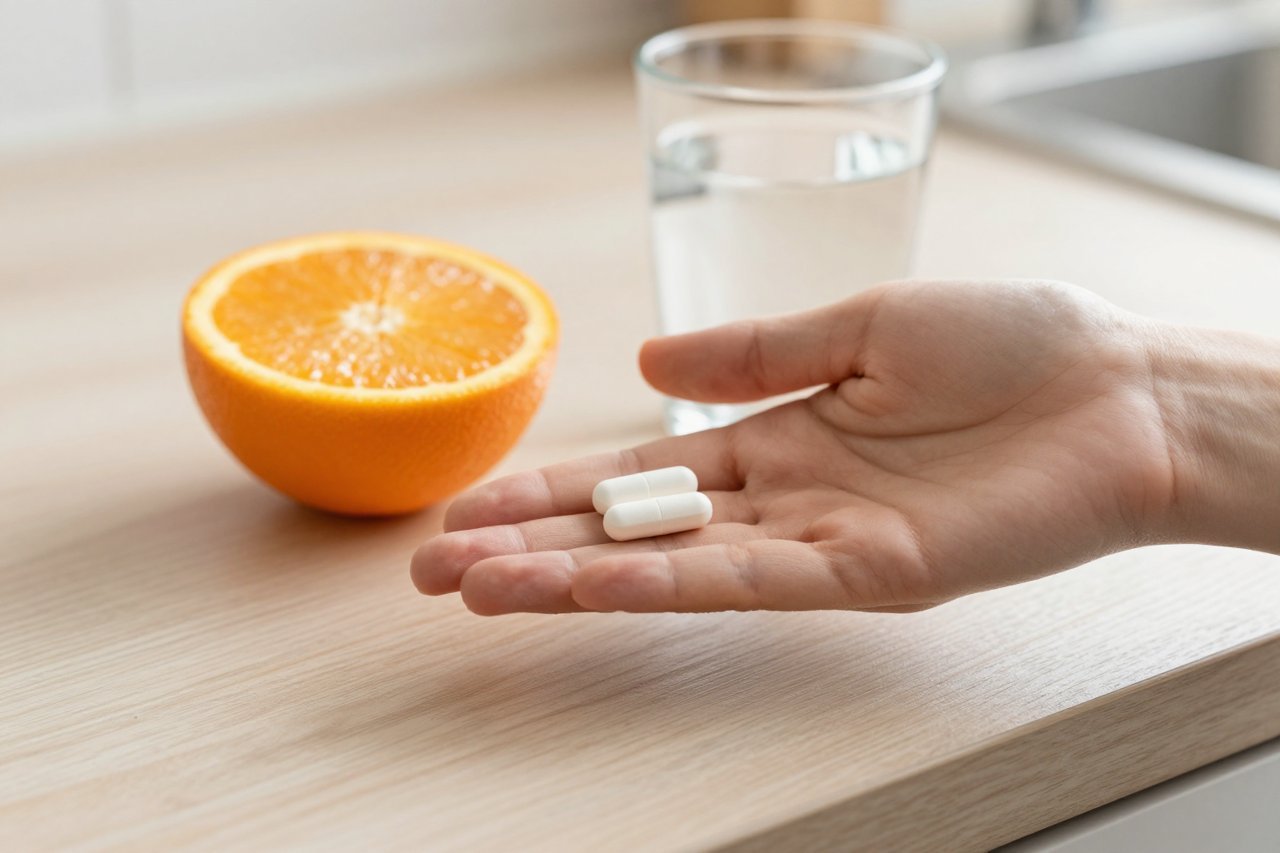
The bottle says 1,000 mg. Your gut may have other plans.
Vitamin C has a reputation as the supplement you can’t overdo. That’s half true — it won’t poison you — but “water-soluble, so you just pee out the extra” skips an important middle step. Before any excess leaves your body, it moves through your intestines, your kidneys, and your bloodstream, and at high enough doses it makes itself felt.
Here’s what the evidence actually shows about vitamin C supplement side effects, who runs into them most often, and how to get the benefits without the fallout.
How much vitamin C is actually too much?
The tolerable upper intake level for adults sits at 2,000 mg per day. That figure isn’t about toxicity — it’s the dose at which diarrhea becomes likely in sensitive people. It’s a practical ceiling, not a target.
Absorption explains why. Your body pulls vitamin C in through transporter proteins that saturate fast. Take about 200 mg in one go and you absorb roughly 90% of it. Push to 1,000 mg and that drops to around half. At 5,000 mg, you’re taking up maybe 20%, and the remainder sits in your bowel drawing water in with it. Plasma levels top out near 70–80 μmol/L once you’re getting a few hundred milligrams daily, so the extra tablets mostly buy expensive urine.
The gut reaction most people hit first
Diarrhea, cramping, bloating, and nausea are the classic vitamin C side effects, and they’re dose-dependent. Because unabsorbed ascorbic acid is osmotically active, it pulls fluid into the large intestine. The result feels a lot like a mild laxative.
The threshold varies enormously. One person sails through 2,000 mg a day without a twinge. Another gets loose stools from 500 mg. People with irritable bowel syndrome, or anyone who has recently taken antibiotics, tend to be more sensitive. If you’re experimenting with a higher dose, splitting it into 250–500 mg portions across the day helps, since each smaller dose gets absorbed more efficiently. Some people also pair vitamin C with bromelain, a pineapple enzyme, hoping for gentler digestion — the evidence for that is thin, but the combination is generally harmless.
Kidney stones: real, but often overstated
This is the side effect that gets the most headlines, and it deserves nuance rather than panic.
Vitamin C breaks down into oxalate in the body, and oxalate is the main building block of the most common kidney stones. Whether supplementing meaningfully raises your risk is still debated. A 2013 Swedish study of around 48,000 middle-aged and older men found that regular ascorbic acid users had roughly double the rate of first-time kidney stones — but the absolute numbers were small, and observational data like this can’t prove cause. Large cohort studies in women, including the Nurses’ Health Study, found no consistent link.
Where the concern is legitimate: anyone with a personal history of stones, a family history, chronic kidney disease, or low fluid intake. If that’s you, staying at or below 1,000 mg a day is sensible, and drinking more water matters far more than trimming your supplement. Don’t cut dietary calcium, either — low calcium actually increases oxalate absorption. If bone health is your reason for supplementing, it’s worth reading up on how vitamin K2 directs calcium into bone rather than soft tissue.
Iron overload in people who don’t need more iron
Vitamin C is one of the most reliable enhancers of non-heme iron absorption — as little as 50 mg alongside a meal can double or triple the amount of plant iron you take up.
For a menstruating adult with low ferritin, that’s a feature. For someone with hereditary hemochromatosis, thalassemia, or a history of transfusions, it’s a problem, because their bodies already store too much iron. Even moderate daily supplementation can nudge ferritin upward in those groups. If you have a genetic iron-loading condition, treat high-dose vitamin C as something to discuss with your hematologist rather than something to take on autopilot.
Medication interactions worth knowing about
Vitamin C isn’t inert, and a few interactions are genuinely practical.
- Chemotherapy and radiation: the theory is that antioxidants could blunt treatments that work partly through oxidative damage. Human evidence is mixed and inconclusive, but most oncologists prefer patients avoid high doses during active treatment. Talk to your team before starting anything above a standard multivitamin.
- Warfarin: case reports describe reduced INR in people taking large doses, possibly from altered warfarin metabolism. If you’re on a blood thinner, tell your prescriber and keep your intake steady rather than swinging between 200 mg and 3,000 mg.
- Laboratory tests: high-dose vitamin C can skew some blood glucose meters, fecal occult blood tests, and certain creatinine assays. If you have a fasting blood draw or a colon cancer screening coming up, pause supplements for 48–72 hours unless your doctor says otherwise.
- Aluminum-containing antacids: in people with kidney failure, vitamin C increases aluminum absorption, which is a real hazard in that population.
IV vitamin C plays by different rules
Intravenous vitamin C produces blood levels ten to a hundred times higher than anything you can reach orally, and the risk profile shifts with it. Documented problems include acute kidney injury in people with pre-existing kidney disease, hemolysis in those with G6PD deficiency, and electrolyte disturbances. IV vitamin C isn’t inherently dangerous, but it needs screening first — blood work, kidney function, G6PD status — rather than a drip at a walk-in clinic.
The smaller annoyances: reflux, teeth, and sodium
Ascorbic acid is genuinely acidic, with a pH around 2.5 in solution. If you already deal with GERD or gastritis, a 1,000 mg tablet can produce heartburn within minutes. Buffered forms — sodium ascorbate or calcium ascorbate — trade some of that acidity for a gentler stomach, though sodium ascorbate carries roughly 110 mg of sodium per 1,000 mg, which matters if you’re on a low-salt diet for blood pressure or heart failure.
Chewable vitamin C is a quiet threat to tooth enamel. People who chew them like candy, several a day for years, sometimes end up with erosion on the back surfaces of their front teeth. Take chewables with water, or switch to capsules. True allergy is rare — occasional rash or hives — and anaphylaxis is vanishingly uncommon.
Who should check with a doctor before supplementing
For most healthy adults, 200–500 mg a day is unremarkable. Get advice first if any of these apply:
- Kidney stones now or in the past, or reduced kidney function
- Hemochromatosis, thalassemia, or any iron-overload condition
- G6PD deficiency
- Active chemotherapy or radiation treatment
- Warfarin or another blood thinner
- Pregnancy — the upper limit stays at 2,000 mg, and there are case reports of rebound scurvy in newborns of mothers taking very large doses
Getting the benefits without the fallout
Almost everything vitamin C does — collagen synthesis, immune cell function, antioxidant recycling — is achieved at doses well below where side effects start. A few hundred milligrams a day is enough to saturate your plasma. A single red bell pepper carries about 150 mg; a kiwi, around 70 mg.
If you do supplement, keep individual doses at 500 mg or less and take them with food, which slows delivery and reduces stomach upset. Skip the 3,000 mg megadose habit unless a doctor has a specific reason. Hydrate well, especially if you’re anywhere near the stone-risk category.
And if your goal is antioxidant support rather than just hitting the RDA, think about the network instead of a single nutrient. Vitamin C regenerates vitamin E and works alongside other compounds — quercetin and ubiquinol both have their own evidence base and dosing considerations, and neither comes with a diarrhea ceiling at 2,000 mg. Modest, consistent intake beats dramatic bursts every time — and your gut will thank you for it.
