 1-800-656-4211




Blog
Soursop Benefits: What This Spiky Tropical Fruit Actually Does for Your Body

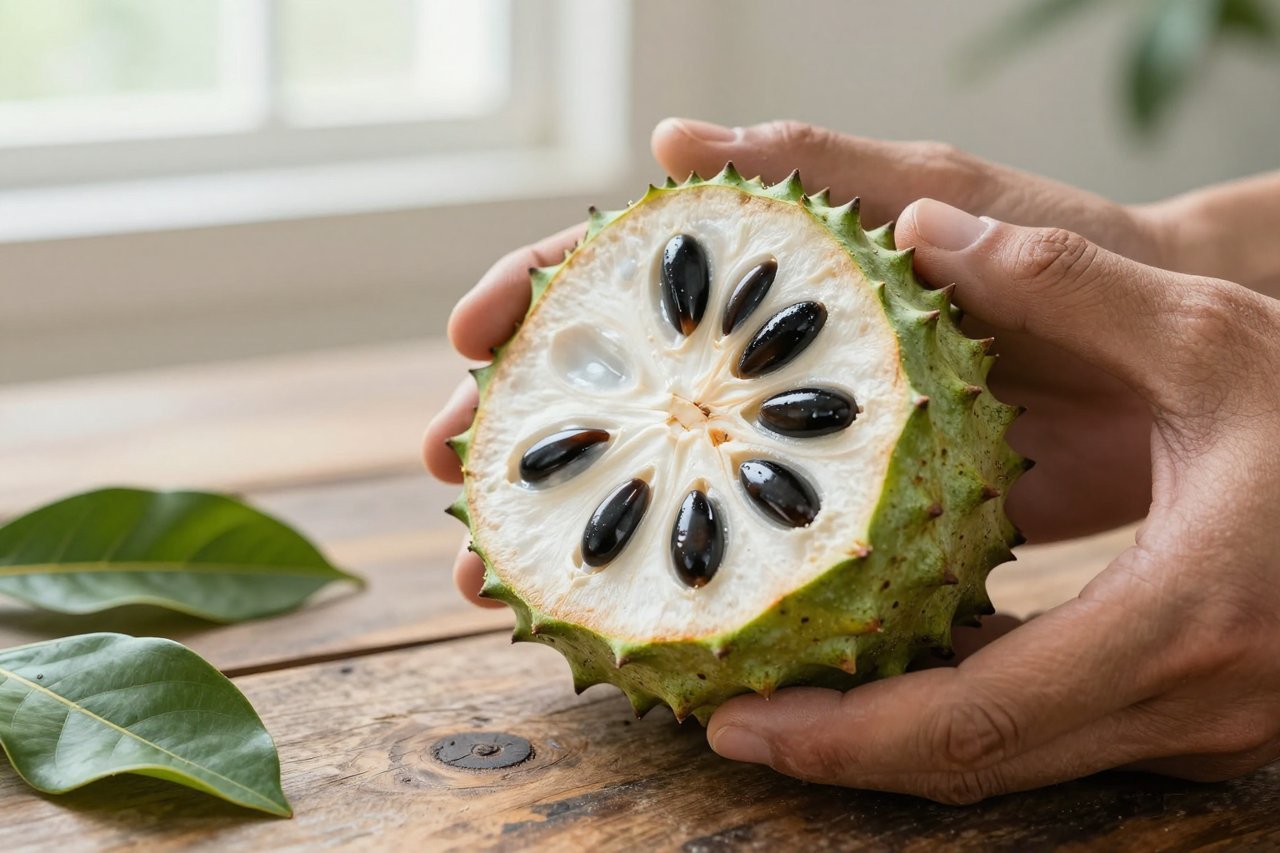
Soursop looks like something the ocean coughed up: a lumpy dark-green fruit the size of a rugby ball, covered in soft spines that bend instead of pricking. Cut it open and you get snow-white pulp studded with glossy black seeds, smelling like pineapple crossed with strawberry and a faint whiff of cream. In the Caribbean it’s guanábana. In Brazil and parts of Africa, graviola. In Kerala it’s mullatha or lakshmana phal. People have eaten the fruit and brewed its leaves for generations, and the internet has since turned it into a superfood with a side of conspiracy theory.
Type “soursop benefits” into a search bar and you’ll see claims running from better sleep to shrinking tumours. Some of what the fruit does is genuinely supported. Some of it is laboratory work that has been wildly over-interpreted. Here’s an honest look at both.
What’s actually inside the fruit
Soursop is mostly water, but the pulp carries a decent nutrient profile for something that tastes like dessert. In roughly 100 grams of fresh raw pulp (about half a cup, scooped off the seeds), you get:
- 66 calories and around 14 grams of naturally occurring sugars
- 3.3 grams of fibre, most of it insoluble
- About 20 mg of vitamin C, roughly a quarter of the daily target for an adult
- 278 mg of potassium, more than a small banana delivers
- 21 mg of magnesium plus smaller amounts of thiamine, niacin, folate, iron and calcium
Beyond vitamins, the fruit and leaves contain polyphenols, flavonoids, alkaloids, and a family of compounds called acetogenins. Those last ones are the reason soursop gets so much attention, and we’ll come back to them.
Not the same as sweetsop
People mix these up constantly. Sweetsop (Annona squamosa), also called sugar apple or custard apple, is a different species with segmented, knobbly skin and no spines. Both are Annonas, but the research and the safety warnings are specific to soursop, so keep them separate in your head.
Antioxidants: a real, if modest, strength
Soursop pulp and leaf extracts show up repeatedly in test-tube studies as effective free-radical scavengers. Leaf extracts in particular contain high concentrations of phenolic compounds, and lab work has measured meaningful antioxidant activity against oxidative stress markers.
What that means in a human body after a glass of soursop juice is much harder to pin down. There are no large controlled trials showing that eating soursop lowers inflammation or prevents chronic disease in people. The vitamin C and polyphenols are a plus, and they’re part of a healthy diet, but they aren’t a treatment.
Blood sugar and appetite
This is one of the more interesting areas. Several animal studies using soursop leaf extract have reported lower fasting blood glucose in diabetic rats, and some researchers have linked it to improved insulin sensitivity. The fibre in the pulp also slows how quickly sugar hits your bloodstream, which is why whole fruit behaves differently from fruit juice.
Human data is thin. Nobody has run a proper randomised trial giving people soursop and tracking their HbA1c. If you take metformin or insulin, treat soursop as food rather than medicine, and mention it to your doctor if you start drinking leaf tea regularly. There is a theoretical risk of blood sugar dropping too low when concentrated extracts stack on top of medication.
Heart markers worth knowing about
At 278 mg of potassium per 100 grams, soursop is a useful contributor to the 3,500 mg or so most adults need daily. Potassium helps counter sodium and ease tension in blood vessel walls. The magnesium does similar quiet work.
Some rat studies with soursop leaf extract have shown reduced systolic blood pressure, and traditional medicine in several countries uses the leaves for exactly that. Again, extrapolating from rats to humans is a leap. The fruit itself is a reasonable part of a heart-friendly diet, particularly as a swap for sugary desserts.
Digestion and gut comfort
With 3.3 grams of fibre per 100 grams, soursop helps move things along. In the Caribbean and parts of South America, unripe fruit and leaf preparations have traditionally been used for the opposite problem, diarrhoea and dysentery, likely because of astringent tannins and antimicrobial compounds.
Lab studies back up the antimicrobial angle to a point. Soursop leaf extracts have inhibited Staphylococcus aureus, E. coli and some Candida strains in petri dishes. That’s a promising signal for future research, not a reason to skip antibiotics.
The cancer question, handled carefully
Search around soursop long enough and you’ll hit dramatic claims. They trace back to genuine science, just not the kind that translates directly.
Acetogenins isolated from soursop leaves, seeds and bark have shown cytotoxic activity against various cancer cell lines in laboratory experiments. Purdue University researchers did much of the early work in the 1990s and filed patents on the compounds. That is real and worth studying.
What it is not: evidence that soursop treats cancer in humans. There are no published clinical trials showing that eating the fruit or drinking the tea shrinks tumours or extends survival. Cancer organisations have been explicit about this, and the risk of someone delaying surgery or chemotherapy to drink graviola tea instead is serious and documented. Capsules sold as “graviola extract” are supplements, not regulated drugs, and their acetogenin content is all over the place.
The safety side nobody mentions
Soursop contains annonacin, a neurotoxic compound found mainly in the seeds, leaves and bark. In Guadeloupe, researchers studying unusually high rates of atypical parkinsonism found an association with long-term, heavy consumption of Annona muricata leaves and fruit. The pattern suggested decades of daily exposure, not an occasional smoothie. Still, it’s a good reason to be moderate.
Practical precautions:
- Never eat or blend the seeds. They’re toxic and should be spat out or removed entirely.
- Don’t drink strong leaf tea every single day for years. Occasional use is the sensible middle ground.
- Avoid soursop and its leaf preparations during pregnancy. Traditional use as an abortifacient is well documented in several regions.
- Check with a pharmacist if you take blood pressure or diabetes medication, or anything with a narrow therapeutic window.
- Stick to the fruit and skip concentrated extracts unless a doctor supervising you says otherwise.
Choosing and eating it without the fuss
A ripe soursop gives slightly when you press it, and the stem end softens first. The skin often darkens and may split, which is normal. If it’s rock hard, leave it on the counter for two or three days, then refrigerate once it’s ready.
To serve it, halve lengthways, scoop the pulp, and pull out the seeds with your fingers. The flesh goes into smoothies with yoghurt or coconut milk, gets frozen into sorbet, or is simply eaten cold with a spoon. It also makes a decent chilled drink blended with a little lime. Freeze leftover pulp in bags and it keeps for months.
A reasonable serving
Half a cup to a cup of pulp a few times a week is a sensible amount for most healthy adults. That gives you fibre, vitamin C, potassium and some antioxidants without pushing annonacin intake into the range researchers worry about. If you’re managing diabetes, count the natural sugars. If you’re pregnant, skip it. Fresh fruit beats a capsule every time, and no single fruit, however exotic, does the job of a varied diet, sleep, and movement. Soursop is a genuinely nice addition to that picture. It just isn’t the whole picture.
