 1-800-656-4211




Blog
Acacia Fiber Benefits and Side Effects: What 10 Grams a Day Really Does

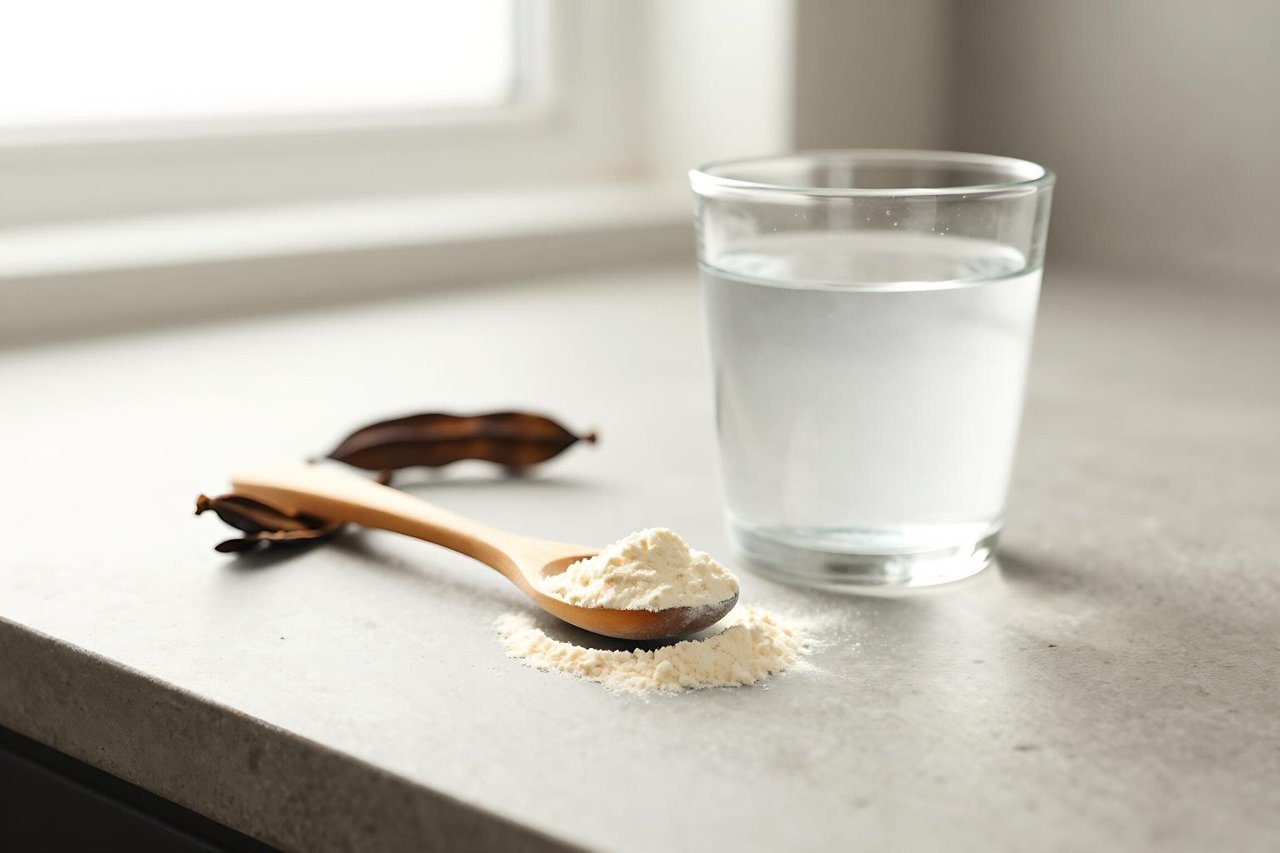
Acacia fiber has a reputation problem in reverse. Most fibers get a bad name because they bloat people. Acacia gets a good name because it usually doesn’t. That gentleness is real, and it’s the main reason the powder keeps showing up in gastroenterologists’ offices and low-FODMAP kitchens. It’s also why people are genuinely surprised when a heaped teaspoon stirred into their morning water leaves them gassy and rumbling by lunch.
Both things are true at once. Acacia is one of the better-tolerated soluble fibers on the shelf, and it can still cause bloating, loose stools, and cramping if you start too fast or take it at the wrong dose for your gut. Here’s what it actually does, where it falls short, and how to trial it without a miserable week.
What you’re actually buying
Acacia fiber is the dried, hardened sap of acacia trees, harvested across the Sahel and mostly in Sudan. The food industry has used it for decades as gum arabic, or E414, an emulsifier that keeps flavour oils suspended in soft drinks and gives chewy candy its bounce. As a supplement it arrives as a fine, off-white powder that dissolves into a faintly cloudy liquid with almost no grit and a slightly woody sweetness.
Roughly 85 to 90 percent of the powder is soluble fiber, and that fiber ferments slowly. Slow fermentation is the whole selling point. Fast-fermenting fibers like inulin feed bacteria hard and produce a lot of gas in the process. Acacia feeds them at a walking pace.
The benefits that hold up
It feeds the bacteria you want without wrecking the ones you don’t
Acacia is a genuine prebiotic. Trials at 10 grams a day over three to four weeks have shown measurable increases in Bifidobacteria and Lactobacilli, alongside reductions in some less helpful strains. What makes it unusual is the combination: it’s fermentable enough to work as a prebiotic, but low-viscosity, so it doesn’t turn your gut contents into a gel the way psyllium does. Psyllium is soothing but barely fermented. Inulin ferments hard and often painfully. Acacia sits in the middle.
Reasonable evidence in IBS, especially the loose end
Small trials in people with irritable bowel syndrome have reported reduced abdominal pain and improved stool consistency at 10 to 15 grams daily over four to eight weeks. The results are modest and the studies are small, so treat this as promising rather than proven. Anecdotally, it tends to suit diarrhea-predominant IBS better than constipation-predominant, because it adds fermentable substrate and mildly slows transit rather than drawing in water to soften things.
If your main problem is hard, infrequent stools, acacia is not your best first choice. It’s not a bulk laxative.
Modest effects on blood sugar and cholesterol
Taken with a meal, acacia slows gastric emptying and blunts the post-meal glucose spike. The effect is real but small, in the range of a few percent, and nowhere near what you’d get from changing what’s on the plate. Cholesterol data is similar: trials using 10 to 25 grams a day show LDL reductions of a few percentage points. Useful if you’re already doing the bigger things right. Not a substitute for any of them.
It’s easy to actually take
This matters more than it sounds. Psyllium turns to gel within seconds and demands a full glass of water and immediate drinking. Acacia stirs into yogurt, coffee, smoothies, and oatmeal without thickening them into paste, and a serving runs about 10 to 20 calories. A supplement you’ll still be taking in three months beats one with better theoretical benefits.
Side effects and why they happen
Gas and bloating in the first week
This is the most common complaint and it’s mechanical. You’re introducing fermentable substrate to a bacterial population that isn’t used to it. Some people notice nothing. Others get visible distension and extra wind for five to ten days before it settles. Starting at 3 to 5 grams and holding there for a week eliminates most of it.
Loose stools and cramping at higher doses
Above roughly 20 to 25 grams a day, or at much lower doses in sensitive people, acacia starts pulling water into the bowel and you get urgency, soft stools, or cramping. It’s dose-dependent and reversible. If you’re sprinting to the bathroom, cut the dose in half rather than quitting entirely.
The low-FODMAP catch nobody mentions
Acacia contains measurable fructans. A product certified low-FODMAP at a 5-gram serving isn’t automatically low-FODMAP at 15 grams. If you’re in the strict elimination phase of a low-FODMAP diet and you’re following a 15-gram protocol you read about online, you may be reintroducing exactly the thing you’re trying to avoid. Stay at the certified serving size until you’re past elimination.
Who should be cautious
- Anyone with an acacia or legume-pollen allergy. Rare but documented: hives, wheezing, throat tightness. If you react to acacia pollen, skip it.
- People on tightly timed medication. Soluble fibers can slow absorption of drugs including levothyroxine, metformin, and lithium. Leave a two-hour gap either side of your dose.
- Active SIBO flares or recent gut surgery. Adding fermentable fiber mid-flare tends to make things worse. Talk to your clinician first.
- Pregnancy and breastfeeding. Acacia as a food additive is fine. Supplement doses aren’t well studied, so ask before starting.
- Children. No established pediatric dose.
How to take it without regrets
Start with 3 to 5 grams, about one level teaspoon, once a day for five to seven days. Add another 3 to 5 grams each week until you hit 10 to 15 grams, split across two doses. Mix into at least 250 ml of water or a meal, and drink extra water through the day. Take it with food if blood sugar response is your goal; timing matters less for the prebiotic effect.
Keep a two-line note on your phone each evening for the first fortnight: gas on a 0 to 3 scale, and stool type on the Bristol scale. Two weeks of data beats two months of guessing.
Acacia versus psyllium versus inulin
- Acacia: slow-fermenting prebiotic, low viscosity, best tolerated by most people, weakest laxative effect.
- Psyllium: strong bulking laxative for constipation, minimal gas, but gritty texture and a gel that demands fast drinking.
- Inulin or chicory root: cheapest prebiotic and effective, but the most gassy by a wide margin. It’s the usual culprit hiding in fibre blends.
What to check on the label
Buy single-ingredient acacia, listed as gum arabic or acacia fiber, with nothing else in the tub. Blends that combine it with chicory root or inulin are cheaper to make and much more likely to cause the gas you were trying to avoid. Watch serving sizes, since some brands list a 5-gram serving to keep the numbers tidy while the effective dose is three times that. Third-party testing matters here because acacia is an agricultural import with a long supply chain and little regulatory scrutiny.
A two-week test that actually tells you something
Run 5 grams daily for week one, then 10 grams daily for week two, taken with breakfast. At the end, ask three questions. Did your worst symptom improve by at least a point? Did the gas fade by day ten? And would you keep buying it at the price you paid?
Two yeses is a keep. If gas is still ramping up at day ten, drop to 5 grams or stop; your microbiome may simply not want more. If nothing changed at all after a month at 10 to 15 grams, the honest answer is that acacia isn’t the missing piece for you, and a different fiber or a different approach is worth the money instead. Few supplements tell you that clearly. This one does, if you give it a fortnight and pay attention.
