 1-800-656-4211




Blog
Marine Phytoplankton: The Invisible Forest That Runs the Ocean

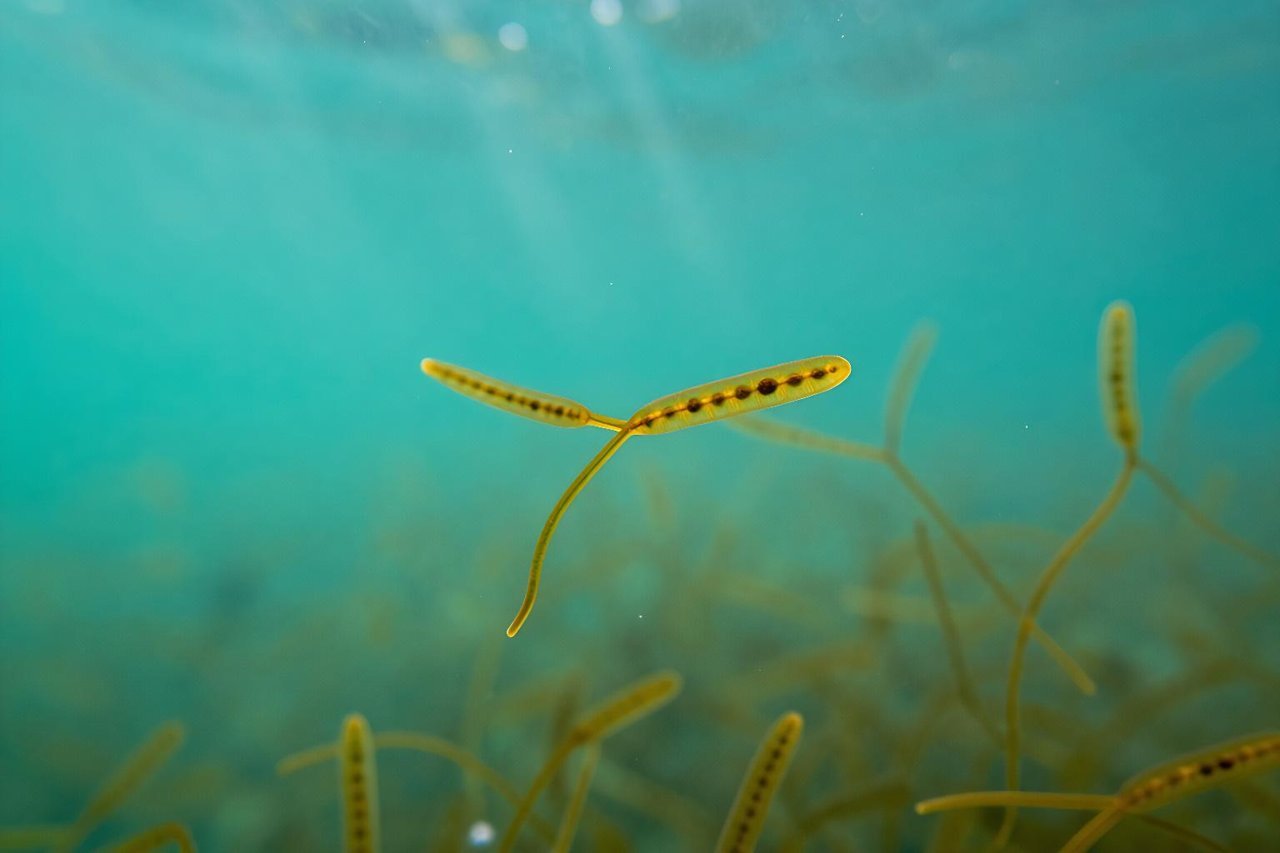
Drag a fine mesh net through almost any stretch of open ocean and bring it up, and the water in the cod end looks like a smear of green-brown dust. That dust is marine phytoplankton: single-celled organisms so small that a teaspoon of seawater can hold several thousand of them, and so abundant that they anchor nearly every food web in the sea.
They are not a species, or even a single kingdom. The word describes a lifestyle. Anything tiny, drifting, and capable of photosynthesis gets filed under the same label, which is why two cells sitting side by side in the same drop of water can be less closely related than you are to a mushroom.
An Umbrella Term, Not a Family Tree
Marine biologists break the group down by what you can see under a microscope or detect in a water sample:
- Diatoms build glass-like shells of silica and often link into long chains. They dominate cold, nutrient-rich water and are a favourite meal for grazing copepods.
- Coccolithophores are wrapped in tiny calcium carbonate plates. Blooms of Emiliania huxleyi turn patches of ocean milky turquoise and can be spotted from orbit.
- Dinoflagellates swim with whip-like flagella. Some produce the toxins behind shellfish poisoning, others glow blue when the water is disturbed.
- Cyanobacteria such as Prochlorococcus and Synechococcus are the smallest and most numerous photosynthetic cells on Earth. Trichodesmium, a larger relative, blooms in warm water so nutrient-poor that it pulls nitrogen straight out of the air.
Size is the one thing they share. Prochlorococcus measures about 0.6 micrometres across. A human hair is roughly a hundred times wider. Put one of these cells on a printed full stop and it would vanish into the ink.
The Oxygen You Breathe Has Saltwater Origins
Land plants get most of the credit for the air in the room, and they deserve some of it. Around half of global photosynthesis happens in the ocean, though, and marine phytoplankton do the heavy lifting. The popular shorthand is that every second breath you take comes from the sea. The exact split between ocean and land is still argued over, but the ocean’s share of the planet’s oxygen production sits close to the halfway mark.
Most of that oxygen gets consumed again by respiring animals and microbes in the same water. What matters over geological time is the small fraction of carbon that sinks out of the sunlit layer and stays buried, because that is what leaves extra oxygen behind in the atmosphere.
Life at the Bottom of the Food Web
Almost everything larger than a grain of rice in the sea depends on phytoplankton, either directly or a few steps up the chain. Copepods and krill graze on blooms. Anchovies and sardines eat the grazers. Tuna, seabirds, and humpback whales eat the small fish. Energy transfer between each step runs at roughly 10%, so it takes an enormous mass of tiny cells to raise one whale. A feeding humpback can put away a tonne or two of krill in a day, and every one of those krill was built on phytoplankton.
Pumping Carbon Into the Deep
Not all the carbon fixed at the surface moves up the food chain. A good share of it gets packaged into sticky clumps and dead cells, then drifts downward for weeks or months.
Marine snow
That falling material is called marine snow, and researchers estimate that somewhere between 5 and 12 billion tonnes of carbon sink out of the sunlit layer every year. A portion reaches the seafloor a kilometre or more below, where it can stay locked away for centuries. The whole process is one reason the ocean has absorbed close to a third of the carbon dioxide humans have released.
Phytoplankton influence the weather too. Certain species release dimethyl sulfide, a gas that oxidises in the atmosphere into particles that help water vapour condense. More phytoplankton can mean more cloud nuclei, which is one reason biologists find the group interesting far beyond the food web.
Blooms You Can See From Space
In the North Atlantic, spring triggers one of the largest recurring biological events on the planet. As winter mixing stops and sunlight returns, diatoms multiply fast enough to colour hundreds of thousands of square kilometres of water. Satellites have tracked ocean colour since 1997, when SeaWiFS launched, and NASA’s PACE mission, launched in February 2024, now resolves the mix of species in a bloom rather than just the total chlorophyll.
Ship-based records reach back further. The Continuous Plankton Recorder has been towed behind commercial vessels across the North Atlantic since 1931, making it one of the longest running biological surveys anywhere. Between the satellites and that towed net, scientists have nearly a century of data on how the base of the ocean’s food web rises and falls.
When a Bloom Turns Harmful
Not every bloom is good news. When Karenia brevis multiplies along Florida’s Gulf Coast, it releases a neurotoxin that kills fish, closes beaches, and triggers coughing fits in people nearby. Similar events cause paralytic and amnesic shellfish poisoning, which is why coastal shellfish beds get shut for testing. Fertiliser runoff, sewage, and warmer water all give these species an edge.
Other blooms are merely strange. Noctiluca scintillans lights up breaking waves along parts of Tasmania and California with a blue glow produced by a chemical reaction inside each cell. Swimmers wading through it come out looking like they have been dipped in starlight.
A Warming Ocean Shifts the Base of Everything
Phytoplankton need two things to arrive at the same time: sunlight from above and nutrients from below. Warming surface water makes the top layer lighter and harder to mix, which traps nutrients in the deep and starves the sunlit zone. Nutrient-poor subtropical gyres have been expanding, and the species that thrive in lean conditions tend to be the smallest ones.
Whether total phytoplankton is declining worldwide is genuinely unsettled. One widely cited analysis reported a drop of about 1% per year across the twentieth century, while other researchers using different data found little or no trend. What most scientists agree on is that the composition is changing, and shifts at the base of a food web rarely stay at the base for long.
The Supplement Aisle Version
Marine phytoplankton is sold in capsules and powders, usually with claims about energy, detoxification, or cellular health. The marketing borrows credibility from the biology. Omega-3 fatty acids really are made by phytoplankton, and the EPA and DHA in fish oil got there because fish ate organisms that ate phytoplankton. That does not mean a capsule delivers the same result. Doses are small, and claims about treating disease are not backed by good human trials. Anyone considering it should talk to a doctor first, especially if they take blood thinners or have thyroid issues, since some products carry iodine.
Why Tiny Cells Tell Us So Much
Phytoplankton respond within days to changes in light, temperature, and nutrients, so their abundance acts as a fast readout on ocean health. A satellite image of chlorophyll, a net sample, or a pigment reading taken from a research vessel all amount to the same signal: how well the surface layer is feeding itself.
That signal matters far beyond marine biology. Fisheries managers use it to forecast stocks, climate modellers use it to estimate how much carbon the ocean will take up, and anyone who cares about the air in their lungs has a stake in it too.
Seeing it for yourself is easier than it sounds. Coastal blooms show up as green swirls in free satellite imagery, and a cheap plankton net towed off a pier on a calm summer evening will usually bring up something that twitches under a magnifying glass. The ocean’s most important organisms are also among the easiest to find, as long as you know to look small.
